How to Send Money To/From Iran

OFAC sanctions against Iran impose strict restrictions on financial transactions between Iran and other countries, including the United States and Europe. The main goal of these sanctions is to influence Iran’s policy. They are aimed at ending support for terrorism, limiting the development of the nuclear program, and drawing attention to human rights violations, as well as isolating Iran from the global financial system. They include a ban on banking operations, freezing of assets, and other financial restrictions.
It is crucial to understand the stakes involved. Violating OFAC sanctions is a strict liability offense. As of 2026, civil penalties for sanctions violations can reach up to $368,136 per violation or twice the value of the transaction, whichever is greater. These penalties apply even if the violation was unintentional.
For private individuals wishing to send money to Iran, these restrictions present significant challenges. This approach is intended to limit Iran’s economic resources for actions that may threaten international security. If you need assistance, contact lawyer for OFAC licensing.

Family remittances may be permitted under a general license, but the payment route decides whether the funds arrive or get blocked. We confirm which license covers your transfer and advise on a compliant banking route.
Check if my transfer is legal →Transfer Money to/from Iran
Transferring money between Iran and the USA or Europe has become extremely difficult due to strict restrictions by the Office of Foreign Assets Control (OFAC). Banking relations between the countries are officially prohibited. This means that traditional methods, such as SWIFT, are unavailable. The lack of access to such standard tools forces people to look for alternative ways to transfer money from their bank accounts to Iran. For specific rules on bank wire transfers to Iran and which payment channels remain OFAC-compliant, see our dedicated guide. Most often, private intermediaries or small financial services in a third country operating outside the traditional banking system are used for this purpose. Note: cryptocurrency transfers involving Iran are not a legal alternative — they carry the same OFAC prohibitions as direct bank transfers.
Since direct “U-Turn” transactions (Iran-US) are prohibited, legal transfers typically involve a transparent banking chain through a third country (e.g., Turkey, UAE, or EU). The legal route usually looks like this: Iranian Bank (Non-SDN) → Third Country Bank → Correspondent Bank → US Bank. However, this is only permissible if the underlying transaction is authorized by a General or Specific License.
To make a money transfer to Iranian banks, it is necessary to obtain a license or use the services of intermediaries. Intermediaries usually provide the opportunity to bypass sanctions, but this is often associated with high risks, including the possibility of fraud or legal complications. In addition, such transfers are often accompanied by high fees.
Many intermediaries operate via the “Hawala” system (informal value transfer). While common in the region, using an unlicensed money transmitter is a violation of US law (31 CFR § 560.550 requires funds to pass through the formal banking system). Using Hawala can lead to funds being seized without recourse.
Before conducting a transaction, it is necessary to determine whether the transfer falls under the current OFAC licenses. If the transaction does not fall under these licenses, you will need to apply for a special permit. For example, if you are sending money to Iran to support your family (personal remittances), it is important to provide a detailed description of the purpose of the transfer and prove that it is a non-commercial operation.
Our company provides professional legal assistance in this process. We will help you gather the necessary documents, submit the application, and monitor its review, ensuring transparency and security for your money transfer operation to Iran.
How to Send Money Legally
Don’t rely on forums. Get professional legal advice on family remittances, student support, and asset transfers permissible by OFAC.
Get Legal AdviceOFAC General License
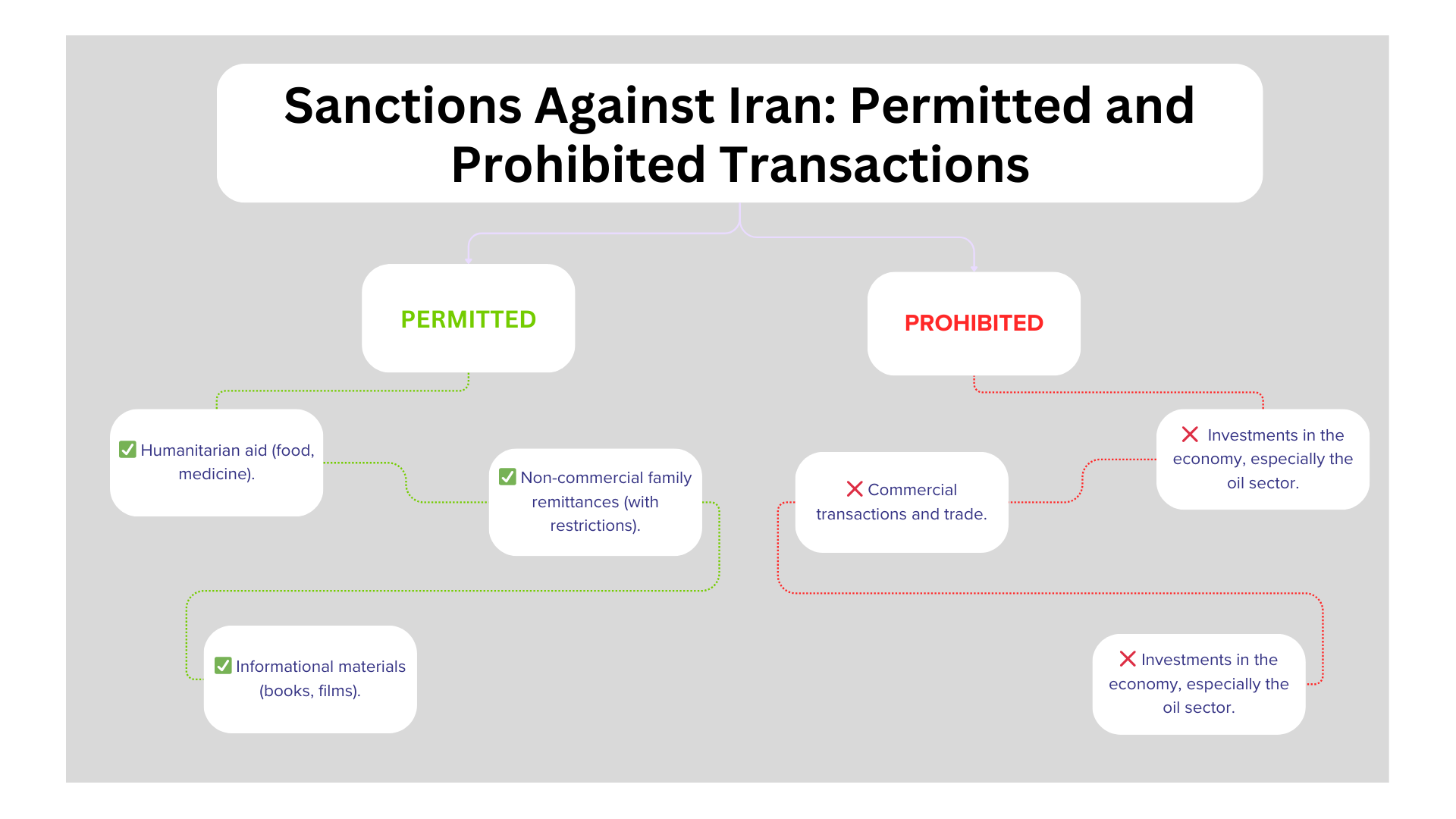
OFAC General licenses allow certain transactions to be conducted without obtaining additional permissions. The existing general licenses are intended to facilitate financial operations that do not pose a threat to the security and policies of the United States. Such licenses permit personal money transfers if they are non-commercial. Other authorized cash transactions include payment of medical expenses and support for humanitarian projects. These operations often involve funding patient treatment, supporting charitable organizations, or providing basic needs for families in difficult situations.
To be specific, the following General Licenses are most relevant for individuals:
- 31 CFR § 560.550: Authorizes non-commercial personal remittances (e.g., family support) to/from Iran, provided they are processed through the banking system and do not involve sanctioned (SDN) entities.
- 31 CFR § 560.543: Authorizes the sale of real property in Iran and transfer of proceeds to the US, only if the property was acquired before the individual became a US person or was inherited.
- General License M-2: Covers certain exports of agricultural commodities, medicine, and medical devices.
- General License D-2: Facilitates the export of software/hardware to support internet freedom in Iran.
You do not need to notify regulatory authorities if you are conducting operations under a general license. However, it is important to ensure that none of the parties to the transaction are included in OFAC SDN list. If one of the parties to the transaction is on this list, the transaction will be blocked. In such cases, this may lead to fines or other legal consequences. If you want to learn how to remove your name from the SDN list, contact our lawyers. We will assist you in resolving this issue, guiding you through all stages of the process.

| License | Permitted transactions | Conditions |
|---|---|---|
| 31 CFR § 560.550 | Non-commercial personal remittances (e.g., family support) | Processed through the banking system and do not involve sanctioned (SDN) entities |
| 31 CFR § 560.543 | Sale of real property in Iran and transfer of proceeds to the US | Acquired before the individual became a US person or was inherited |
| General License M-2 | Exports of agricultural commodities, medicine, and medical devices | — |
| General License D-2 | Export of software/hardware to support internet freedom in Iran | — |
OFAC Special License
Special OFAC licenses from the Treasury Department are required for operations not covered by general licenses. These include complex transactions, such as transferring large sums, purchasing or selling real estate, as well as commercial deals. For example, if you plan to invest in an Iranian business or sell property in Iran, you will need a special license.
While selling inherited property often falls under a General License (§ 560.543), purchasing new property or selling property acquired after moving to the US almost always requires a Specific License. Misinterpreting this distinction is a common reason for blocked funds.
To send money to an Iranian bank account under a special license, you need to submit an official application. The application must include information about all parties involved in the transaction, the transfer amount, and its purpose. For example, if you are transferring a significant amount of money to pay for a contract, copies of the contract and financial documents must be attached.
The application process is quite complex and requires compliance with all requirements. Our team of lawyers will help you complete the application, prepare the documents, and ensure that the process goes as smoothly as possible. We can also provide consultation on additional requirements or potential risks in your situation.
Transferring Money to/from Iran with Cryptocurrency
The use of cryptocurrencies for transferring money between Iran and the USA has become popular due to sanctions regulations on traditional financial channels. OFAC allows the use of cryptocurrencies, but this method also has its risks. Cryptocurrency transactions are not always regulated in the same way as traditional financial operations. This creates opportunities to bypass Iran sanctions but can also lead to serious legal consequences.
The landscape for cryptocurrency has changed drastically. In 2025 and early 2026, OFAC began sanctioning entire cryptocurrency exchanges and wallet clusters associated with Iranian traffic (e.g., recent actions against platforms like Zedcex). Blockchain analytics firms (like Chainalysis) now flag wallets interacting with Iranian IPs. Using USDT (Tether) for transfers is no longer a “grey area”—it is strictly monitored, and assets can be frozen on the blockchain level.
When sending money to Iran using cryptocurrencies, it is important to comply with all applicable rules and regulations. For example, you must know the exact source of funds and ensure that all parties involved in the transaction adhere to OFAC rules. If the transaction is found to be illegal, it may result in funds being blocked or legal proceedings. Cryptocurrencies provide speed and convenience, but you should not underestimate the risks associated with their use. If you want to learn more about the safe use of cryptocurrencies for transfers, contact our lawyers. We will provide you with recommendations for optimal solutions.


OFAC Iranian Lawyers
If you encounter difficulties when trying to transfer money to Iran or from Iran, our team of lawyers is ready to help. We specialize in issues related to OFAC sanctions and have extensive experience with licensing. Our goal is to provide you with a safe and legal way to conduct financial transactions. In many cases, these issues are closely connected with sanctions in Iran, and people often wonder if it is legal to send money to Iran.
We will help you determine which license is required in your case and will assist you at every stage. We will also ensure that all documents are thoroughly reviewed and that your activities comply with current legislation. With us, you will receive professional support that will help you avoid mistakes and minimize risks. Our specialists are ready to answer all your questions and find the optimal solution for your situation. If the transfer relates to funds inherited from Iran, additional licensing requirements apply. See our guide on Iran inheritance and OFAC sanctions.


FAQ
Is it legal to send money to Iran?
Sending money to Iran is not automatically unlawful, but it is tightly restricted. A transfer may proceed when a General or Specific License authorizes the underlying transaction, and personal remittances can qualify when they are non-commercial, use the banking system, and avoid sanctioned entities. Transfers outside applicable authorization can be blocked and may create legal consequences.
Can money be transferred between Iran and the United States or Europe through ordinary banking channels?
For transfers involving Iran and the United States or Europe, ordinary banking channels are generally unavailable because official banking relations are prohibited, including SWIFT. A lawful structure may use a transparent chain through a third-country bank and a correspondent bank, but it is allowed only when a General or Specific License authorizes the underlying transaction.
Can family support payments be sent to Iran?
Family support payments may fall under a General License when they are personal and non-commercial. The sender should provide a detailed explanation of the transfer’s purpose, show that it is not commercial, and ensure processing through the banking system without an SDN party. The payment route still matters, because funds can be blocked if the conditions are not met.
When is a Special OFAC License required for sending money to Iran?
A Special License is needed for transactions that do not fit within a General License. Examples include certain large transfers, commercial transactions, and some real-estate dealings. The application must identify every participant, state the amount and purpose, and include supporting materials such as contracts and financial records when relevant.
Can cryptocurrency be used to transfer money to Iran?
Cryptocurrency is not a risk-free workaround for transfers involving Iran. Transactions must comply with OFAC requirements, including verifying the source of funds and the parties involved. Iranian-linked exchanges, wallets, and USDT activity are subject to monitoring, and assets may be frozen. An unlawful transaction can result in blocked funds or legal proceedings.