OFAC Country Sanctions List
August 2026
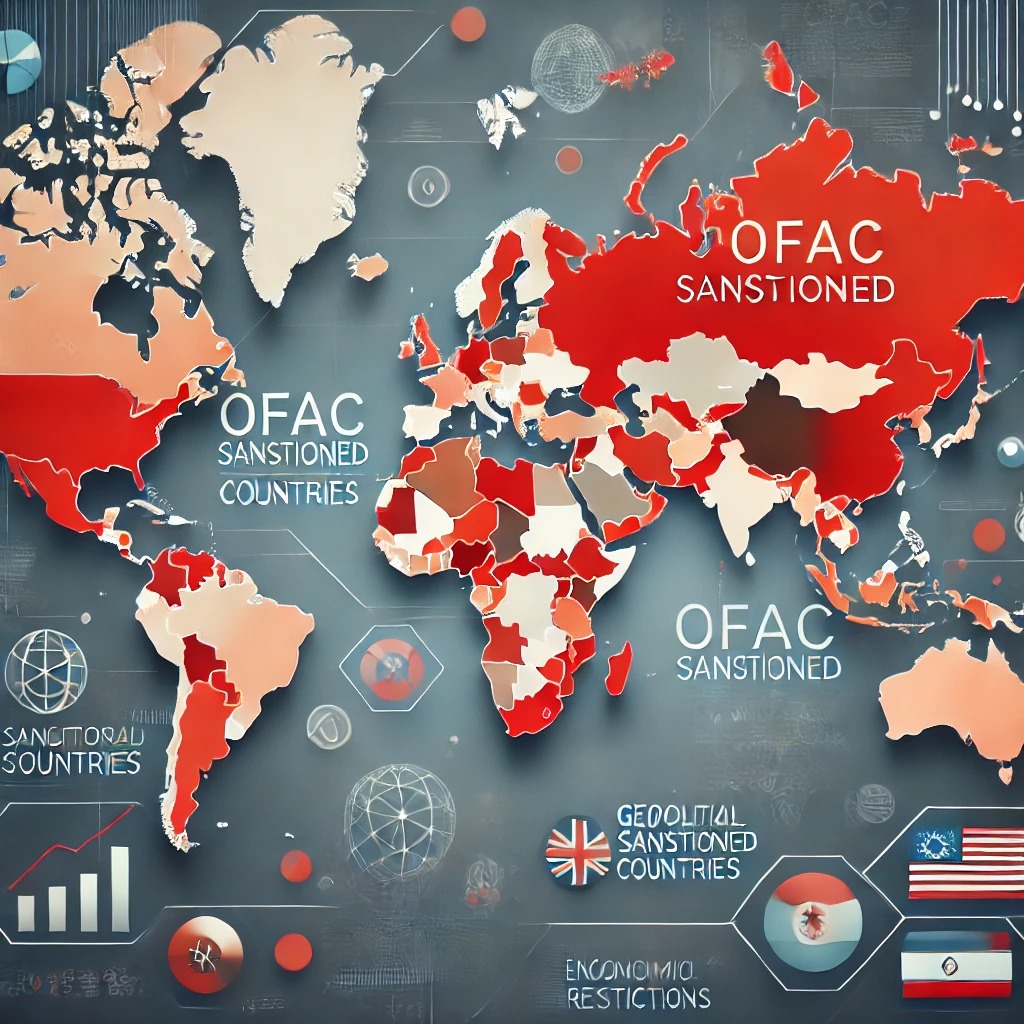
OFAC Sanctioned Countries List for 2026
Not every country on this list faces the same level of restriction. OFAC sanctions programs fall into three distinct tiers, and the practical requirements — and the risk of triggering secondary sanctions — differ significantly between them.
Comprehensive embargoes — virtually all trade, financial transactions, and dealings are prohibited without a specific OFAC license, regardless of whether a particular individual or company is separately designated:
- Cuba Sanctions against Cuba have been in effect since the 1960s in response to the nationalization of American property and human rights violations.
- Iran Sanctions were imposed due to support for terrorism, the nuclear program, and human rights violations.
- Iran — sanctions imposed over support for terrorism, its nuclear program, and human rights violations.
- North Korea: Sanctions were imposed due to the nuclear weapons program and regular violations of international agreements in North Korea.
- Syria — comprehensive trade and investment ban.
- Crimea, Donetsk, and Luhansk regions of Ukraine — sanctioned since 2014 following Russia’s annexation of Crimea and support for separatist forces in the Donetsk and Luhansk regions.
Hybrid / heavily sectoral programs — not full embargoes, but broad sectoral restrictions layered on top of an unusually large and fast-growing set of SDN designations:
- Russia sanctions imposed in response to the 2014 annexation of Crimea, election interference, and the military conflict in Ukraine. Restrictions target the financial, energy, and defense sectors, and increasingly reach foreign financial institutions through secondary sanctions even where no US nexus exists.
- Belarus — sectoral sanctions closely aligned with the Russia program.
- Venezuela — the Government of Venezuela remains blocked, though specific general licenses for the energy sector may apply depending on current policy.
List-based (targeted) programs — no country-wide ban; restrictions apply only to specific individuals, entities, or sectors designated on the SDN List or another restricted-party list, so most transactions with non-designated parties remain lawful subject to screening:
Afghanistan, the Balkans, Burma (Myanmar), Central African Republic, Democratic Republic of the Congo, Ethiopia, Hong Kong, Iraq, Lebanon, Libya, Mali, Nicaragua, Somalia, South Sudan, Sudan, and Yemen.
For most operations involving comprehensively or hybrid-sanctioned countries or regions, a General License (covering routine categories of transactions) or a Specific License (requiring an individual application to OFAC) is required to ensure compliance and protect against potential fines.
| Country or region | Program tier | Key restriction |
|---|---|---|
| Cuba | Comprehensive embargoes | virtually all trade, financial transactions, and dealings are prohibited |
| Iran | Comprehensive embargoes | virtually all trade, financial transactions, and dealings are prohibited |
| North Korea | Comprehensive embargoes | virtually all trade, financial transactions, and dealings are prohibited |
| Syria | Comprehensive embargoes | comprehensive trade and investment ban |
| Crimea, Donetsk, and Luhansk regions of Ukraine | Comprehensive embargoes | virtually all trade, financial transactions, and dealings are prohibited |
| Russia | Hybrid / heavily sectoral programs | Restrictions target the financial, energy, and defense sectors |
| Belarus | Hybrid / heavily sectoral programs | sectoral sanctions closely aligned with the Russia program |
| Venezuela | Hybrid / heavily sectoral programs | the Government of Venezuela remains blocked |
| Afghanistan | List-based (targeted) programs | no country-wide ban |
| The Balkans | List-based (targeted) programs | no country-wide ban |
| Burma (Myanmar) | List-based (targeted) programs | no country-wide ban |
| Central African Republic | List-based (targeted) programs | no country-wide ban |
Need an OFAC License for a Sanctioned Country?
Working with Cuba, Iran, North Korea, Syria or another restricted jurisdiction? We assess whether a general license applies, prepare specific license applications, and help you stay compliant.
Get a license consultation →What does it mean OFAC-Sanctioned Countries?
The Office of Foreign Assets Control (OFAC) manages U.S. sanctions programs aimed at protecting the national interests of the United States under authority granted primarily by the International Emergency Economic Powers Act (IEEPA). OFAC oversees the Specially Designated Nationals and Blocked Persons List (SDN List), which includes individuals, companies, and — for comprehensively embargoed jurisdictions — entire countries subject to specific restrictions. These obligations apply to U.S. persons: any entity organized under U.S. law, any U.S. national wherever located, and any person physically present in the United States regardless of nationality.
Countries under OFAC sanctions are jurisdictions recognized as violating international norms or posing a security threat — through support for terrorism, proliferation of weapons of mass destruction, illegal arms trade, or interference in electoral processes. Support for regimes actively involved in terrorist activity, for example, can trigger country-level sanctions directly.
Individuals and entities on the SDN List have their assets frozen or blocked and are barred from entering the United States. Businesses conducting transactions with SDN-listed parties — or with entities 50% or more owned by them under OFAC’s 50% Rule — risk losing access to the U.S. financial system entirely, since U.S. correspondent banks are legally required to block the transaction the moment a designated party is involved.
If you or your company has been added to the SDN List, our lawyers can assist with a delisting petition under 31 CFR § 501.807, or with securing the appropriate license to continue operating in compliance with OFAC requirements.
Types of OFAC Sanctions
The Office of Foreign Assets Control (OFAC) sanctions regulations can take various forms depending on the purpose and nature of the violation. The main types of sanctions are:
- Trade restrictions: A ban on export, import, or any commercial operations with countries or companies under sanctions, including cargo that only transits or is transshipped through a sanctioned jurisdiction without being delivered there. For example, restrictions on the export of technologies to countries with a high risk of human rights violations.
- Freezing of assets: All financial resources belonging to individuals or legal entities included in the SDN list are blocked. This significantly limits the ability to conduct financial transactions.
- Travel ban: Individuals under sanctions are prohibited from entering the United States. This applies to both private individuals and government officials.
These measures and sanctions regulations are aimed at reducing the economic activity of targeted actors and maintaining global security.
Traveling, Sending Money or Shipping Goods to a Sanctioned Country?
Travel-related payments, remittances and cargo passing through sanctioned jurisdictions can trigger OFAC restrictions. We explain what is permitted, what requires authorization, and how to avoid penalties.
Get legal advice →Global Sanctions and Activity-Based Sanctions
While this page details the list of countries sanctioned by the US, it’s important to recognize that sanctions are a global foreign policy tool. Other major bodies like the European Union, the United Kingdom, and the United Nations maintain their own global sanctions lists, which can overlap with but are distinct from the OFAC list of countries. Multinational businesses must often screen against multiple lists to ensure full compliance.
Activity-Based Sanctions
In addition to country-specific programs, OFAC administers numerous activity-based sanctions programs. These do not target a specific geographic OFAC country but rather focus on particular malign activities. This means individuals or entities can be sanctioned for their conduct, regardless of their location. Key activity-based programs target:
- Counter Terrorism;
- Counter Narcotics Trafficking;
- Cyber-Related Activities;
- Human Rights Abuses and Corruption (Global Magnitsky);
- Proliferation of Weapons of Mass Destruction.
These programs underscore why simply avoiding the OFAC sanctioned countries list currently in effect is not enough for a robust compliance strategy. Screening all counterparties against the SDN list is essential to avoid dealing with a person sanctioned under an activity-based program, even if they operate in an un-sanctioned country.
OFAC vs. ITAR — Don’t Confuse the Two
OFAC’s country sanctions are separate from the State Department’s International Traffic in Arms Regulations (ITAR), which governs defense articles and technical data, and from the Commerce Department’s Export Administration Regulations (EAR), which cover dual-use goods. A country can be off OFAC’s sanctions list and still be restricted under ITAR or EAR, or vice versa. If your matter involves military or dual-use goods, you likely need both an OFAC review and a State or Commerce Department review.
The Impact of Engagement with Sanctioned Countries
Interaction with individuals or organizations from sanctioned countries, especially in international traffic, can lead to serious consequences. First and foremost, there are financial losses, as any assets related to such transactions may be frozen. In addition, this entails legal complications, including significant fines and lawsuits. For example, a company that knowingly ignores sanctions may face multimillion-dollar fines, and its management could be subject to criminal prosecution.
Reputational risk compounds the financial exposure. Companies known to transact with sanctioned jurisdictions risk losing the confidence of banking partners and clients — a dynamic that has driven widespread de-risking, where correspondent banks simply exit relationships with entire regions or client categories rather than manage the compliance burden case by case.
Contact OFAC Attorney
If you are doing business with a country under sanctions, as a United States person, you will definitely need the help of a lawyer to avoid legal issues. A qualified specialist will help you obtain the necessary licenses, ensure compliance with OFAC regulations, and avoid potential fines or criminal liability.
What to Do Next
- Screen your counterparty against the SDN and sectoral sanctions lists before any transaction.
- Determine if you need a license — general licenses cover many routine transactions; specific licenses require an application.
- Traveling to a comprehensively sanctioned country? U.S. persons generally need OFAC authorization even for personal travel-related transactions in Cuba, Iran, North Korea, and Russia.
Contact us for assistance, and we will Contact us for assistance, and we can provide informational materials to help you resolve all issues related to OFAC sanctions efficiently and professionally.
FAQ
How many countries does OFAC sanction?
There is no single official number, because OFAC’s sanctions programs operate at different levels. A handful of jurisdictions — currently Cuba, Iran, North Korea, Syria, and the Crimea/Donetsk/Luhansk regions — are under comprehensive embargo. A larger group, including Russia, Belarus, and Venezuela, faces heavy sectoral restrictions without a full embargo. Beyond that, dozens of countries have specific individuals, companies, or sectors designated on the SDN List without the country itself being sanctioned as a whole. Any single number (“5 countries,” “6 countries”) only reflects one of these tiers and omits the others.
Is the OFAC sanctioned countries list the same as the SDN List?
No. The Specially Designated Nationals and Blocked Persons List (SDN List) names specific individuals, companies, and vessels — it is not organized by country. The “sanctioned countries list” on this page is a separate, higher-level classification showing which countries are subject to comprehensive or sectoral restrictions as a whole. A person or company can appear on the SDN List regardless of whether their home country is comprehensively sanctioned, which is why screening a specific counterparty against the SDN List is still necessary even when dealing with a non-embargoed country.
How often is this list updated?
OFAC updates its sanctions programs on a rolling basis — new SDN designations, general licenses, and executive orders can be issued at any time, sometimes multiple times per month during periods of active geopolitical change like the current Russia and Venezuela programs. This page is reviewed and updated whenever a change affects country-level restrictions; the “Last reviewed” date at the top reflects the most recent check.
If a country isn’t on this list, is it automatically safe to do business with?
Not necessarily. Being outside a comprehensive embargo or sectoral program does not clear a transaction automatically. A specific counterparty in an otherwise unrestricted country can still be individually designated on the SDN List, or be 50% or more owned by a designated party under OFAC’s 50% Rule. Country-level status is a starting point for risk assessment, not a substitute for screening the actual parties involved in a transaction.