Home
How to Send Money To/From Iran

Sending money to Iran became far more restricted in 2026. On August 24, 2026, OFAC suspended the general license that for more than a decade allowed U.S. persons to send noncommercial, personal remittances to family in Iran, and since September 10, 2026 it reviews Iran-related license requests with a presumption of denial.
Violating Iran sanctions is a strict liability offense: civil penalties can reach $377,700 per violation or twice the value of the transaction, whichever is greater, even if the violation was unintentional.
Before you wire, carry or send any funds, check whether your transfer can still be authorized. If you need help, contact a lawyer for OFAC licensing.

- How to Send Money To/From Iran
- Is It Legal to Send Money to Iran in 2026?
- What Changed on August 24 and September 2026
- Can You Wire Money to Iran?
- Exchange houses, hawala and payment apps
- Is There Still a Legal Way to Support Family in Iran?
- What a specific license application should contain
- Receiving Money from Iran: Inheritance and Sale of Property
- Cryptocurrency Is Not a Workaround
- What If You Already Sent Money to Iran?
- FAQ
- Is it legal to send money to Iran in 2026?
- What is 31 CFR § 560.550?
- Can I still send money to my family in Iran?
- Can I carry cash to Iran for my relatives?
- Can money be transferred to Iran through a bank in Turkey, the UAE or Europe?
- Can cryptocurrency be used to send money to Iran?
- Can I receive an inheritance or sale proceeds from Iran?
Updated October 2026
Is It Legal to Send Money to Iran in 2026?
For U.S. persons, in most cases no longer without a specific license. Until August 2026, 31 CFR § 560.550 authorized noncommercial, personal remittances to and from Iran — family support sent through a U.S. bank and a third-country bank, or funds carried by the sender personally. On August 24, 2026, OFAC’s final rule, effective August 24, 2026 stayed that authorization indefinitely, so new family transfers, gifts and support payments to or from Iran are no longer covered by a general license. A short wind-down license, General License BB, allowed only transfers that were already in progress to be completed, and it expired on September 8, 2026.
Getting an individual (specific) license has also become harder: since September 10, 2026, OFAC reviews Iran-related license applications with a presumption of denial, except where the law requires otherwise or where there is a risk to life, limb or environmental safety, which the applicant must attest to in writing.
These rules bind U.S. citizens and permanent residents wherever they are, anyone in the United States and U.S. companies. Under 31 CFR § 560.215, foreign entities owned or controlled by U.S. persons are also bound. Non-U.S. persons outside the United States are not directly bound by them, but any transfer that touches a U.S. bank or U.S. dollars is caught, and many non-U.S. banks and payment services refuse Iran-related payments altogether.
The general license for family remittances is suspended. We assess whether your transfer can still be licensed, prepare the specific license application and advise on transfers that are already blocked or returned.
Check my transfer →What Changed on August 24 and September 2026
OFAC suspended five authorizations under the Iranian Transactions and Sanctions Regulations (ITSR) on the same day and followed with further steps in September:
| Authorization | What it covered | Status in October 2026 |
|---|---|---|
| 31 CFR § 560.550 | Noncommercial, personal remittances to or from Iran, including funds carried by the sender | Stayed since August 24, 2026 |
| 31 CFR § 560.544 | Certain educational activities by U.S. persons in third countries | Stayed since August 24, 2026 |
| 31 CFR § 560.554 | Conference-related services in the U.S. or third countries | Stayed since August 24, 2026 |
| General License F | Services supporting sports activities and exchanges | Stayed since August 24, 2026 |
| General License G | Certain academic exchanges and educational services | Stayed since August 24, 2026 |
| General License BB | Wind-down of transactions previously authorized by the five provisions above | Expired September 8, 2026 |
| 31 CFR §§ 560.522, 560.528, 560.529 and General License J-1 | Overflight payments, licensing policy on aircraft safety, bunkering and emergency repairs, civil aircraft on temporary sojourn | Stayed since September 8, 2026 (wind-down under General License DD ended September 23, 2026) |
| 31 CFR § 560.530 | Sales of agricultural commodities, medicine and medical devices | Not among the stayed provisions; conditions apply |
| 31 CFR § 560.543 | Sale of property in Iran acquired before becoming a U.S. person or inherited, and transfer of the proceeds | Not among the stayed provisions; check current status before relying on it |

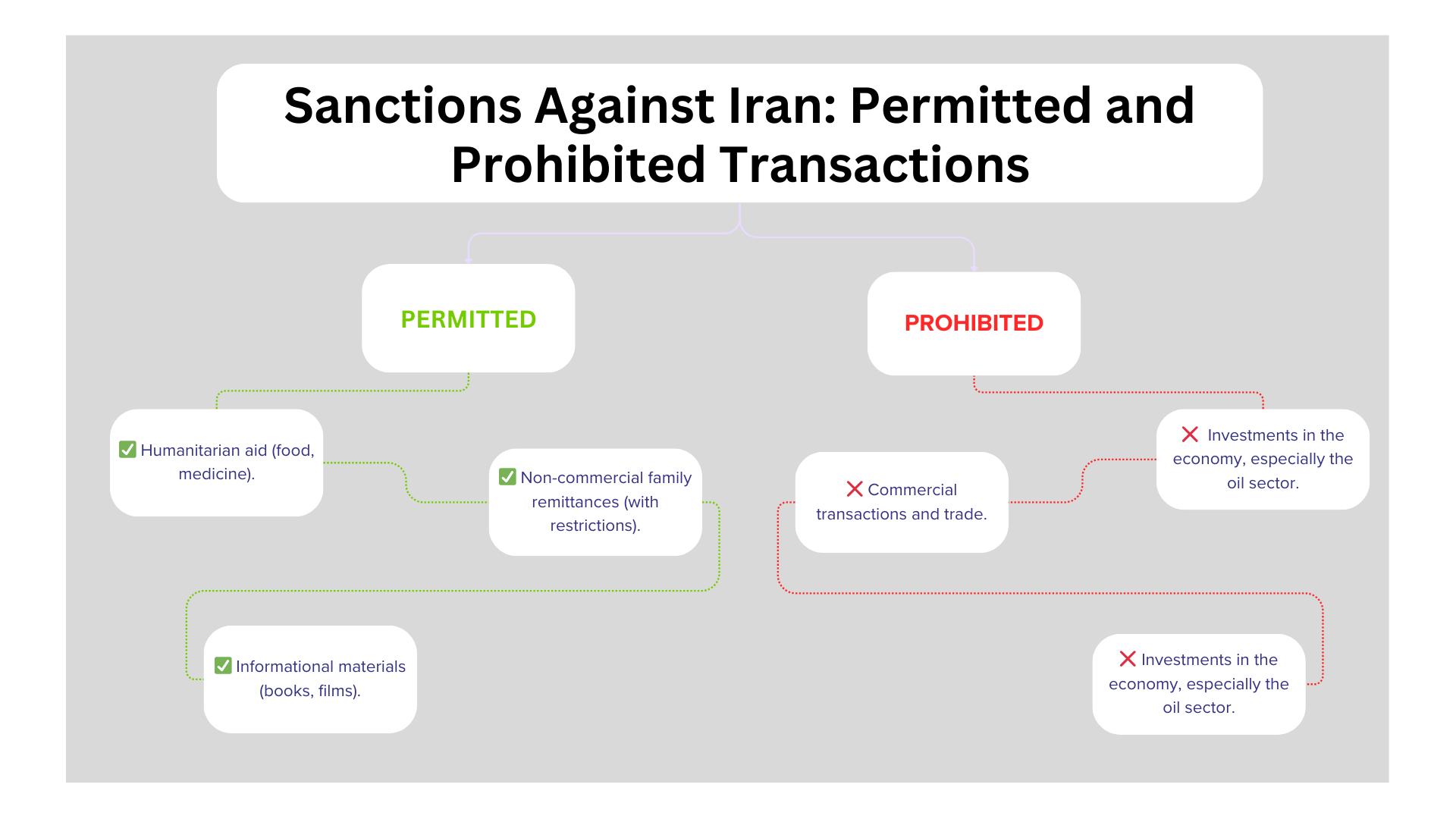
OFAC also extended secondary sanctions risk to non-U.S. persons operating in Iran’s aviation, digital asset, gold, shipping and technology sectors (from August 24, 2026) and its automotive and rail sectors (from October 1, 2026). See our overview of OFAC Iran sanctions and Iran-related secondary sanctions.
Can You Wire Money to Iran?
A wire transfer from or through the United States to Iran is prohibited unless a license authorizes it. Iranian banks are blocked: under 31 CFR § 560.211, property in which the Government of Iran or an Iranian financial institution has an interest is blocked, and U.S. banks must block or reject such transfers. Routing the payment through a bank in Turkey, the UAE or Europe does not make it lawful for a U.S. person: sending funds to Iran indirectly through a third country is treated the same as sending them directly.
Before August 2026, a family remittance could be processed this way under § 560.550. Now a U.S. bank needs to see a specific license before it processes the payment. Banks also apply their own risk policies, and many will not process Iran-related payments even when a license exists.
Exchange houses, hawala and payment apps
Informal value transfer systems such as hawala, unlicensed exchange houses and “friends abroad” arrangements are not a lawful substitute. For a U.S. person they amount to an unauthorized transfer to Iran, and splitting or disguising payments to avoid bank checks can be treated as sanctions evasion, which carries criminal exposure. U.S. money transmitters and payment apps generally list Iran among prohibited countries in their terms of service.
Is There Still a Legal Way to Support Family in Iran?
- Specific license. A U.S. person can apply to OFAC through its online licensing portal for authorization of a particular transfer. Since September 10, 2026 such requests face a presumption of denial; a documented risk to life or health, such as urgent medical treatment, may bring a request within the exception, but OFAC decides case by case together with the State Department. A written attestation with supporting documents is required.
- Goods instead of money. Sales of agricultural commodities, medicine and medical devices are authorized under § 560.530 subject to its conditions; this route is used by exporters, not for sending cash.
- Transfers already blocked or returned. If a remittance sent before the change was stopped, the bank’s notice shows whether the funds were rejected (returned) or blocked; blocked funds can only be released under a license.
What a specific license application should contain
- a description of the transfer: purpose, amount, frequency and the parties involved;
- identification details of the sender and recipient and your relationship to the recipient;
- the proposed payment route, including every bank in the chain;
- documents confirming the source of funds;
- evidence of the medical, humanitarian or other urgent need that brings the request within an exception, with the written attestation OFAC requires;
- for anything other than personal support, the contracts, invoices or estate documents behind the payment.
Applications are filed in English through the OFAC licensing portal. If OFAC grants a license, it states the permitted amount, parties, route and period; anything outside those terms needs a new authorization, and banks will still check that each payment matches the license. See how we prepare an OFAC license application.
Receiving Money from Iran: Inheritance and Sale of Property
Money coming from Iran is subject to the same rules. Section 560.543 authorizes individuals who are U.S. persons to sell real and personal property in Iran that they acquired before becoming U.S. persons or inherited from persons in Iran, and to transfer the proceeds to the United States; it does not cover winding down a business in Iran or reinvesting the proceeds there. It was not among the provisions stayed in August 2026, but banks review these transfers closely and the status should be checked before funds move. For inherited assets, see our guide to Iran inheritance and OFAC licensing.
Cryptocurrency Is Not a Workaround
The ITSR apply to digital assets in the same way as to bank transfers: sending USDT, bitcoin or any other crypto to a person in Iran without authorization is prohibited for U.S. persons. Enforcement has intensified in 2026. On January 30, 2026, OFAC designated the UK-registered exchanges Zedcex and Zedxion — the first time Treasury designated digital asset exchanges for operating in Iran’s financial sector — together with Tron addresses used for stablecoin transfers, and later in the year it extended secondary sanctions risk to Iran’s digital asset sector. Stablecoin issuers can freeze tokens held at sanctioned addresses.
More in our guide to Iran-related crypto transactions.
What If You Already Sent Money to Iran?
Transfers completed before August 24, 2026 under § 560.550 were authorized when made, and those in progress could be completed until September 8, 2026 under General License BB. A transfer made after that without a license may be a violation. Civil penalties under IEEPA reach $377,700 per violation or twice the value of the transaction, and willful violations can lead to criminal fines of up to $1 million and up to 20 years in prison. If a transfer may have violated the rules, a voluntary self-disclosure to OFAC is a significant mitigating factor.
| Why the payment was stopped | Likely outcome |
|---|---|
| No license covers the transfer (including family remittances after August 24, 2026) | Rejected and returned, or blocked if a blocked party has an interest |
| An Iranian bank or other blocked person is involved, directly or indirectly | Blocked under 31 CFR § 560.211; release only under a license |
| Incomplete or inconsistent payment details or purpose | Held for review, then processed or returned |
| The bank’s own risk policy on Iran-related payments | Declined even where a license exists |
If a bank stopped your payment, a sanctions lawyer can establish whether it was blocked or rejected, deal with the bank, prepare a license application to release blocked funds and set up a documented process for future payments. See also how blocked funds are released.


FAQ
Is it legal to send money to Iran in 2026?
For U.S. persons, generally not without a specific OFAC license. The general license for noncommercial personal remittances, 31 CFR § 560.550, was stayed on August 24, 2026, and since September 10, 2026 OFAC reviews Iran-related license applications with a presumption of denial, with exceptions such as risk to life or health.
What is 31 CFR § 560.550?
It is the ITSR general license that authorized noncommercial, personal remittances to or from Iran, such as family support, processed by a U.S. bank or broker-dealer without debiting or crediting an Iranian account, and allowed individuals to carry such funds personally. Its effectiveness was stayed indefinitely on August 24, 2026.
Can I still send money to my family in Iran?
Only with a specific license from OFAC. Applications are filed through OFAC’s licensing portal and face a presumption of denial unless an exception applies, for example urgent medical needs, which must be documented and attested in writing.
Can I carry cash to Iran for my relatives?
No longer under a general license. The authorization to carry funds as a personal remittance was part of § 560.550 and was stayed with it on August 24, 2026.
Can money be transferred to Iran through a bank in Turkey, the UAE or Europe?
Not lawfully by a U.S. person without a license. Sending funds to Iran indirectly through a third country is prohibited in the same way as a direct transfer, and U.S. banks must block or reject payments involving Iranian financial institutions.
Can cryptocurrency be used to send money to Iran?
No. Crypto transfers to persons in Iran are prohibited for U.S. persons in the same way as bank transfers, and OFAC has designated Iran-linked exchanges and wallet addresses, including Zedcex and Zedxion in January 2026.
Can I receive an inheritance or sale proceeds from Iran?
Section 560.543 authorizes U.S. persons to sell property in Iran acquired before they became U.S. persons or inherited from persons in Iran, and to transfer the proceeds to the United States. It was not among the provisions stayed in August 2026, but the status and the bank route should be checked before any transfer.