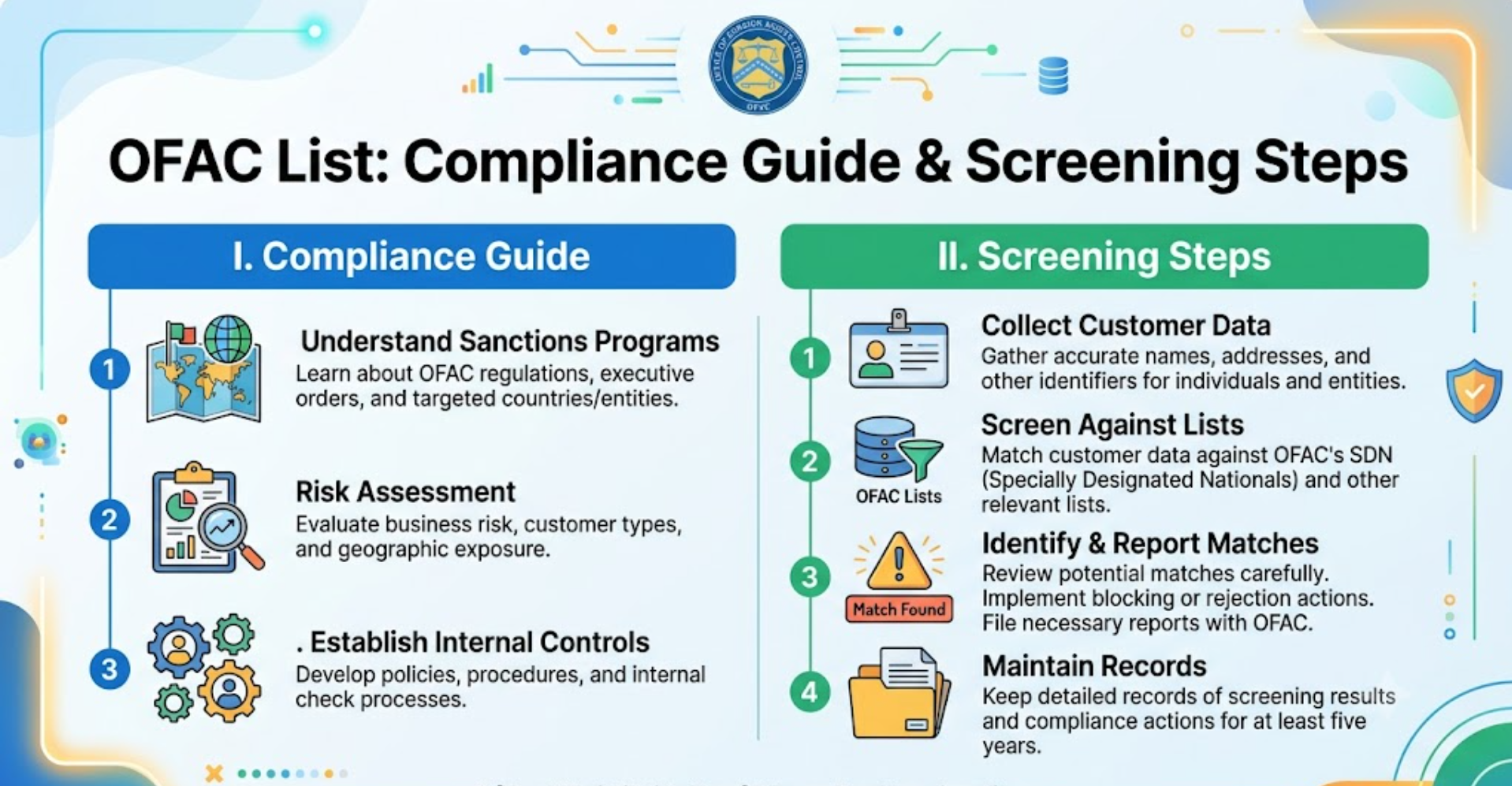
OFAC List: Compliance Guide & Screening Steps

A logistics company in Rotterdam discovered in March 2025 that a routine shipment was blocked mid-transfer because one of its third-party vendors appeared on the U.S. Treasury’s sanctions database. The firm had 48 hours to document its screening procedures before facing potential civil penalties of up to $330,000 per transaction. Its compliance team needed to understand not just who was on the list, but how the entire OFAC system worked.
The OFAC list is the U.S. government’s primary financial blacklist used to freeze assets and prohibit trade with targeted foreign countries, terrorists, international narcotics traffickers, and entities involved in the proliferation of weapons of mass destruction.
What exactly is the OFAC list and who maintains it?
The Office of Foreign Assets Control is a bureau of the U.S. Department of the Treasury established under the International Emergency Economic Powers Act and the Trading with the Enemy Act. OFAC administers more than 30 distinct sanctions programs. Beyond the SDN List—its most widely used screening tool—the agency maintains the Foreign Sanctions Evaders List, the Non-SDN Iran Sanctions Act List, the Sectoral Sanctions Identifications List, the List of Foreign Financial Institutions Subject to Correspondent Account or Payable-Through Account Sanctions, and the Non-SDN Palestinian Legislative Council List.
Each list operates under different legal authorities and imposes different consequences. The SDN List blocks all property and interests in property of designated persons within U.S. jurisdiction or in the possession or control of U.S. persons, wherever located. The Sectoral Sanctions Identifications List imposes more limited prohibitions—typically restrictions on debt or equity transactions with specific maturities rather than a full freeze. Most critical: the consolidated sanctions lists are updated continuously, sometimes multiple times per week, as OFAC issues new designations or removes entries following delisting petitions. A vendor could move from compliant to blocked between your morning and afternoon due diligence check.
OFAC’s legal authority derives from Executive Orders issued under the International Emergency Economic Powers Act (50 U.S.C. § 1701 et seq.) and specific Congressional legislation such as the Countering America’s Adversaries Through Sanctions Act. Designations are policy-driven administrative actions, not criminal convictions. An individual or entity can appear on the SDN List based on activities such as supporting terrorism, weapons proliferation, narcotics trafficking, human rights abuses, or corruption—even if no criminal charges have been filed.
⚠️ Time is critical — every day matters
Get a free case assessment
Our team specialises in cases with an international element. We review applicable treaties, assess risks, and prepare an action plan.
Which countries and entities appear on OFAC’s sanctions lists?
OFAC maintains both comprehensive country-based sanctions programs and targeted designations against specific individuals and entities. Comprehensive programs impose broad prohibitions on nearly all transactions involving certain jurisdictions. As of 2026, these cover Cuba, Iran, North Korea, Syria, and the Crimea, Donetsk, and Luhansk regions of Ukraine. These programs generally prohibit U.S. persons from engaging in any transactions or dealings with persons in those regions or involving property subject to those jurisdictions, subject to limited exceptions and general licenses.
Beyond country embargoes, OFAC designates individuals and entities globally under targeted sanctions programs. The SDN List includes narcotics traffickers designated under the Foreign Narcotics Kingpin Designation Act (21 U.S.C. § 1901-1908), individuals and entities supporting terrorism under various Executive Orders, and actors involved in weapons of mass destruction proliferation under Executive Order 13382. Designations also target persons involved in cyberattacks, election interference, corruption, and human rights abuses in countries not otherwise subject to comprehensive sanctions.
Established in 2014, the Sectoral Sanctions Identifications List targets specific sectors of the Russian economy without imposing a full blocking. Entities on this list face prohibitions on certain debt and equity transactions with specified maturities, rather than a complete asset freeze. The Non-SDN Iran Sanctions Act List identifies persons subject to secondary sanctions—non-U.S. persons who engage in certain activities with Iran may face restrictions on access to U.S. financial markets, but their assets are not blocked.
| Sanctions List Type | Scope | Primary Legal Authority | Asset Blocking? |
|---|---|---|---|
| SDN List | Global individuals/entities | 50 U.S.C. § 1701 (IEEPA), various EOs | Yes – full block |
| Sectoral Sanctions List | Specific Russian/Ukrainian entities | EO 13662 | Partial – debt/equity restrictions |
| Non-SDN Iran Sanctions Act List | Iran-related secondary sanctions | Iran Sanctions Act (P.L. 104-172) | No – access restrictions only |
| Foreign Sanctions Evaders List | Persons evading sanctions | EO 13608 | Yes – full block |
| List of Foreign Financial Institutions | Foreign banks subject to correspondent account sanctions | Various statutes | No – U.S. correspondent account prohibitions |
According to OFAC’s 2023 Annual Report to Congress, the agency removed 1,573 SDN entries that year following successful delisting petitions or policy determinations that the sanctions objectives had been met. The total number of active SDN entries fluctuates as designations are added and removed, but the list contained thousands of individual and entity records as of the most recent update on June 11, 2026.

How do individuals and businesses end up on the OFAC sanctions list?
Designations result from policy decisions made by OFAC in coordination with other U.S. government agencies, including the Departments of State, Justice, and Homeland Security. OFAC publishes press releases announcing new designations with detailed justifications tied to specific Executive Orders or statutory authorities. A designation under Executive Order 13224 (targeting terrorists and those who support terrorism), for instance, requires OFAC to determine that the person has committed, or poses a significant risk of committing, acts of terrorism that threaten U.S. national security, foreign policy, or economic interests.
Here’s what makes OFAC designations different from criminal convictions: they’re administrative, not judicial. No criminal conviction is required, and the evidentiary standard is lower than in criminal proceedings. Designated persons do not receive advance notice or an opportunity to contest the designation before it is imposed. OFAC designations are based on classified and unclassified intelligence, law enforcement reports, diplomatic cables, and open-source information. Once designated, the person’s name is added to the SDN List immediately, and all U.S. persons must block any property or interests in property of the designated person that come into their possession or control.
Designations can be based on direct conduct (e.g., engaging in terrorism, narcotics trafficking, or corruption) or on association with already-designated persons or prohibited regimes. Under the Foreign Narcotics Kingpin Designation Act, OFAC may designate persons who provide material support or assistance to, or act on behalf of, a previously designated kingpin. This “derivative designation” authority extends OFAC’s reach to networks of facilitators and front companies.
Designated persons may submit a delisting petition to OFAC at [email protected] with supporting documentation demonstrating that they no longer meet the criteria for designation or that U.S. sanctions policy objectives would be served by removal. Expect 6 to 9 months for OFAC to review and respond—a timeline that means your cash or assets remain frozen for much of that period. OFAC reviews petitions on a case-by-case basis. Alternatively, designated persons may challenge their designation in U.S. federal court under the Administrative Procedure Act, although courts have historically deferred to OFAC’s national security and foreign policy determinations.
What are the practical steps to conduct an OFAC check on names and entities?
OFAC provides multiple tools for screening names and entities against its sanctions lists. Start with the Sanctions List Search tool at sanctionssearch.ofac.treas.gov. This web-based tool uses approximate string matching algorithms to identify possible matches between user-entered search terms and names or name components in the SDN List and other OFAC sanctions lists. The tool includes a slider-bar that allows users to set a confidence threshold for match closeness, accommodating variations in spelling, transliteration, and word order.
For bulk screening of large volumes of names, OFAC publishes downloadable data files through the Sanctions List Service at ofac.treasury.gov/sanctions-list-service. The most comprehensive file is SDN_ENHANCED.ZIP, which as of June 11, 2026, is 6.32 MB in size and contains structured XML data conforming to OFAC’s enhanced data standard. This file includes alternate names, addresses, dates of birth, passport numbers, and program codes indicating which sanctions authorities apply—essential detail when searching for individuals with common names or transliterated names from non-Latin alphabets.
Implement these due diligence procedures:
- Screen at onboarding – Before you establish any business relationship, check all new customers, vendors, and partners against the SDN List and other applicable sanctions lists. Miss this step and you’ve already created exposure.
- Monitor continuously – Re-screen existing relationships at least quarterly and whenever OFAC publishes list updates. Sanctions designations change frequently, and a partner who was clear six months ago may no longer be.
- Check indirect ownership – Apply the 50 Percent Rule: investigate whether any counterparty is owned 50% or more by a blocked person, even if the counterparty itself doesn’t appear on the SDN List. Shell companies and complex ownership structures are common evasion tactics.
- Document screening procedures – Keep detailed records of all sanctions screening activities, including search parameters, confidence thresholds, and your rationale for accepting or rejecting potential matches. If OFAC comes calling, your documentation is your defense.
- Train staff – Your employees in transaction processing, customer onboarding, and compliance need to understand OFAC requirements and know when to escalate. A single transaction approved by an untrained employee can cost millions in penalties.
Program codes associated with each SDN entry determine what you actually can and cannot do. An entry marked “SDGT” means designation under the Specially Designated Global Terrorist program (Executive Order 13224). “UKRAINE-EO13662” signals Ukraine-related sectoral sanctions. Different codes trigger different prohibitions and may allow different general licenses or interpretive workarounds. Skipping this distinction is a common compliance failure.
Why is due diligence and entity screening essential for regulatory compliance?
OFAC violations carry penalties so severe they can destroy a business. Under the International Emergency Economic Powers Act (50 U.S.C. § 1705), civil penalties reach the greater of $356,579 per violation or twice the underlying transaction amount—and these figures adjust upward each year. Criminal penalties for willful violations: up to $1 million and 20 years in prison for individuals, and up to $20 million or twice the gain/loss for corporations. The per-transaction structure means a single business relationship involving multiple payments can generate dozens or hundreds of separate violations. One client, multiple violations, catastrophic exposure.
U.S. persons—all U.S. citizens, permanent residents, entities formed under U.S. law, and anyone physically in the United States—face strict liability. Your good faith or ignorance that a counterparty was listed does not protect you from civil penalties. Good faith matters only when OFAC decides how much to fine you, not whether you’re guilty. OFAC uses its Economic Sanctions Enforcement Guidelines to weigh factors like voluntary self-disclosure, investigation cooperation, remedial steps, and program adequacy.
Banks and financial institutions operate under different rules entirely. The Bank Secrecy Act (31 U.S.C. § 5311 et seq.) and related regulations (31 CFR Part 501–598) require risk-based sanctions compliance programs including policies, internal controls, testing, training, and designated compliance officers. Examiners from the Office of the Comptroller of the Currency, the Federal Reserve, and Financial Crimes Enforcement Network assess these programs regularly. Deficiencies trigger enforcement actions, consent orders, and separate civil penalties on top of any OFAC violations themselves.
Organizations that discover potential violations have a critical decision: submit a voluntary self-disclosure to OFAC, which can cut penalties by 50% or more compared to violations OFAC uncovers independently. For transactions involving sanctioned jurisdictions, licensing applications, or violations already discovered, professional legal review reduces exposure significantly.
What resources does OFAC provide to help organizations stay current?
OFAC’s official website at home.treasury.gov/policy-issues/office-of-foreign-assets-control-sanctions-programs-and-information hosts materials that most organizations use inadequately:
- Sanctions Programs and Country Information describe each program’s legal authorities, types of prohibitions, and applicable general licenses in detail.
- Frequently Asked Questions – Over 1,000 numbered FAQs. These are not casual guidance. OFAC cites them in enforcement actions and enforcement settlements. Before structuring a complex transaction, read the relevant FAQs.
- General Licenses pre-authorize transaction categories that would otherwise be prohibited. General License 8C under Iranian Transactions Regulations, for example, authorizes certain agricultural commodity and medicine sales to Iran. Using the wrong license—or no license—is a violation.
- Compliance Commitments Framework (May 2019) sets OFAC’s expectations for effective programs: management commitment, risk assessment, internal controls, testing and auditing, training. Use this as your blueprint.
- Enforcement Information – Recent civil penalties and settlements reveal OFAC’s priorities and what factors increase or decrease penalties. Study these cases relevant to your industry.
Transactions not covered by a general license require a specific license (individual license). Submit these through OFAC’s online portal or email with documentation of the proposed transaction, parties involved, and policy rationale. Response times vary by program—complex requests can stretch several months, so plan ahead if you have a business deadline.
OFAC conducts outreach through webinars, industry conferences, and direct engagement with trade associations. The Office of Global Targeting coordinates with foreign governments and international organizations on enforcement and evasion network intelligence. For OFAC licensing, delisting petitions, or enforcement defense, specialized legal counsel experienced in sanctions law ensures requests are properly documented and presented.
| OFAC Resource | Purpose | Access |
|---|---|---|
| Sanctions List Search | Real-time web-based screening | sanctionssearch.ofac.treas.gov |
| Sanctions List Service | Downloadable data files for automated systems | ofac.treasury.gov/sanctions-list-service |
| General Licenses | Pre-authorized transaction categories | Published on program pages |
| FAQs | Interpretive guidance on specific issues | ofac.treasury.gov/faqs |
| Specific License Portal | Application for individual transaction approval | ofac.treasury.gov (electronic submission) |
| Enforcement Actions | Case studies of violations and penalties | ofac.treasury.gov/civil-penalties |


Frequently Asked Questions
What is OFAC list countries?
“OFAC list countries” refers to jurisdictions under comprehensive U.S. sanctions programs administered by OFAC. Cuba, Iran, North Korea, Syria, and the Crimea, Donetsk, and Luhansk regions of Ukraine sit on this list as of 2026. OFAC also designates individuals and entities in non-sanctioned countries through the SDN List, so the term sometimes broadens to mean any country where OFAC has active sanctions targets. Comprehensive country sanctions prohibit nearly all transactions with those jurisdictions, except where specific exemptions or general licenses apply. Violating country-level sanctions carries the same penalties as violating SDN-based restrictions.
How do you get on the OFAC list?
Individuals and entities are designated through Executive Orders, Congressional legislation, or OFAC regulatory authority. The basis: terrorism, weapons proliferation, narcotics trafficking, human rights abuses, corruption, or support for sanctioned regimes. OFAC announces designations by press release with stated justifications—but provides no advance notice or pre-designation hearing. You learn you’re listed when the press release goes out. Designations can rest on direct conduct or on association with already-designated persons. No criminal conviction required. These are administrative, policy-driven actions.
What is Latest OFAC Sanctions List?
OFAC updates its Sanctions List continuously—sometimes multiple times per week—as new designations arrive or existing entries shift. The current version lives at ofac.treasury.gov/sanctions-list-service, where you can download the SDN_ENHANCED.ZIP file. It contains the complete SDN List in structured XML format. As of June 11, 2026, that file was 6.32 MB.
Is it bad to be on the OFAC list?
Severe. Being designated—especially on the SDN List—freezes your assets inside U.S. jurisdiction instantly. All property and interests belonging to you become blocked and inaccessible. U.S. persons cannot pay you, do business with you, finance you, or trade with you. Period.
What is the OFAC SDN List?
The SDN List (Specially Designated Nationals and Blocked Persons List) is maintained by the Treasury Department’s Office of Foreign Assets Control. It names individuals, companies, vessels, and other entities whose property and interests are blocked under U.S. sanctions.
How many people are on the OFAC List?
The number shifts constantly as designations are added and removals occur. OFAC’s 2023 Annual Report documented 1,573 SDN removals that year alone. Mid-2026 figures show several thousand active SDN entries across individuals, corporations, vessels, and aircraft.
What does OFAC stand for and what is its role?
OFAC: Office of Foreign Assets Control, a Treasury Department bureau. It administers and enforces economic and trade sanctions against foreign countries, regimes, terrorist organizations, narcotics traffickers, weapons proliferators, and threats to U.S. national security and foreign policy.