OFAC SSI List: What It Is and Why It Matters in 2026

The Sectoral Sanctions Identifications (SSI) List isn’t your typical government blacklist. Maintained by the U.S. Department of the Treasury’s Office of Foreign Assets Control (OFAC), it identifies individuals and companies in key sectors of the Russian economy. But unlike a total asset freeze, SSI sanctions don’t block everything. Instead, they prohibit very specific transactions, such as dealings in new long-term debt or equity, creating a complex compliance challenge.
Sectoral Sanctions Identifications (SSI) List – An official list published by OFAC that identifies persons operating in sectors of the Russian economy designated under Executive Order 13662. Inclusion on the SSI list subjects a person to specific, non-blocking sanctions that restrict certain financial transactions, such as providing new debt or equity, but does not impose a full asset freeze.
What exactly is the SSI List?
Think of the SSI List as a surgical tool. Created in 2014 under Executive Order 13662, it was a direct response to Russia’s actions in Ukraine. The goal was to apply pressure on critical sectors of the Russian economy—finance, energy, and defence—without the nuclear option of a complete asset block.
Entities on this list are subject to prohibitions found in one or more of four specific “Directives.” These rules dictate exactly which transactions are forbidden. A directive might prohibit U.S. persons from giving a listed Russian bank a loan that matures in more than 14 days. Still, other lawful business, like selling them standard office equipment for cash, would likely be fine. This is the crucial difference from the SDN List — a far more restrictive sanctions instrument. Navigating these targeted measures requires careful review, and many companies consult an OFAC Russia sanctions solicitor to avoid costly mistakes.
From practice: A common mistake is treating an SSI List “hit” the same as an SDN List “hit.” An SDN match means “stop all activity and block assets.” An SSI match means “investigate the transaction” to see if it falls under the specific prohibitions of the relevant Directive. This distinction is critical for avoiding both compliance violations and unnecessary business disruption.
SSI after February 2022: a narrower role. It’s worth being precise about where SSI sits today. After the start of the full-scale invasion of Ukraine, the largest Russian banks and companies that had previously been on the SSI List — including Sberbank, VTB, and Rosneft — were moved off SSI and onto the SDN List under E.O. 14024, meaning they are now subject to full blocking, not the lighter sectoral restrictions. In practice, this means SSI today applies mainly to entities that haven’t (yet) been escalated to a full SDN designation. Treating SSI as the primary tool against Russia’s major banks, as it functioned pre-2022, is an outdated reading of the current sanctions architecture.
What is SSI List OFAC?
When you hear “SSI List OFAC,” it’s simply shorthand. It refers to the Sectoral Sanctions Identifications list that is created, maintained, and enforced by the Office of Foreign Assets Control (OFAC). OFAC is the powerful agency inside the U.S. Treasury tasked with enforcing economic sanctions that align with U.S. foreign policy and national security goals.
How does the SSI List differ from the SDN List?
The main difference between the SSI List and the more infamous Specially Designated Nationals and Blocked Persons (SDN) List is severity. The SDN List imposes a full stop—comprehensive “blocking” sanctions. The SSI List uses a lighter touch with its narrow “sectoral” sanctions.
Get a match on the SDN List, and that entity is effectively walled off from the U.S. financial system. All its property and interests in property under U.S. control are frozen. U.S. persons are forbidden from doing any business with them. An entity on the SSI List, however, is not blocked. U.S. persons are only barred from the specific transactions detailed in the applicable SSI Directive.
These two approaches are classic examples of comprehensive versus targeted sanctions programs. One is a sledgehammer; the other is a scalpel.
| Feature | SSI List (Sectoral Sanctions) | SDN List (Blocking Sanctions) |
|---|---|---|
| Core Prohibition | Prohibits only specific transactions (e.g., new debt/equity) as defined by a Directive. | Prohibits all transactions and dealings; requires blocking of all property and interests in property. |
| Asset Status | Assets are not blocked. | All assets in U.S. jurisdiction must be blocked (frozen). |
| Scope | Narrow and targeted at specific economic activity. | Broad and comprehensive, effectively a total economic ban. |
| Primary Legal Basis | Executive Order 13662 and its four Directives. | Numerous sanctions programmes (e.g., counter-terrorism, counter-narcotics, country-specific). |
| Compliance Action on Match | “Investigate”: Check if the proposed transaction is prohibited by the specific Directive. | “Stop & Block”: Cease all activity, block property, and report to OFAC. |
What is the U.S. Sanctions List?
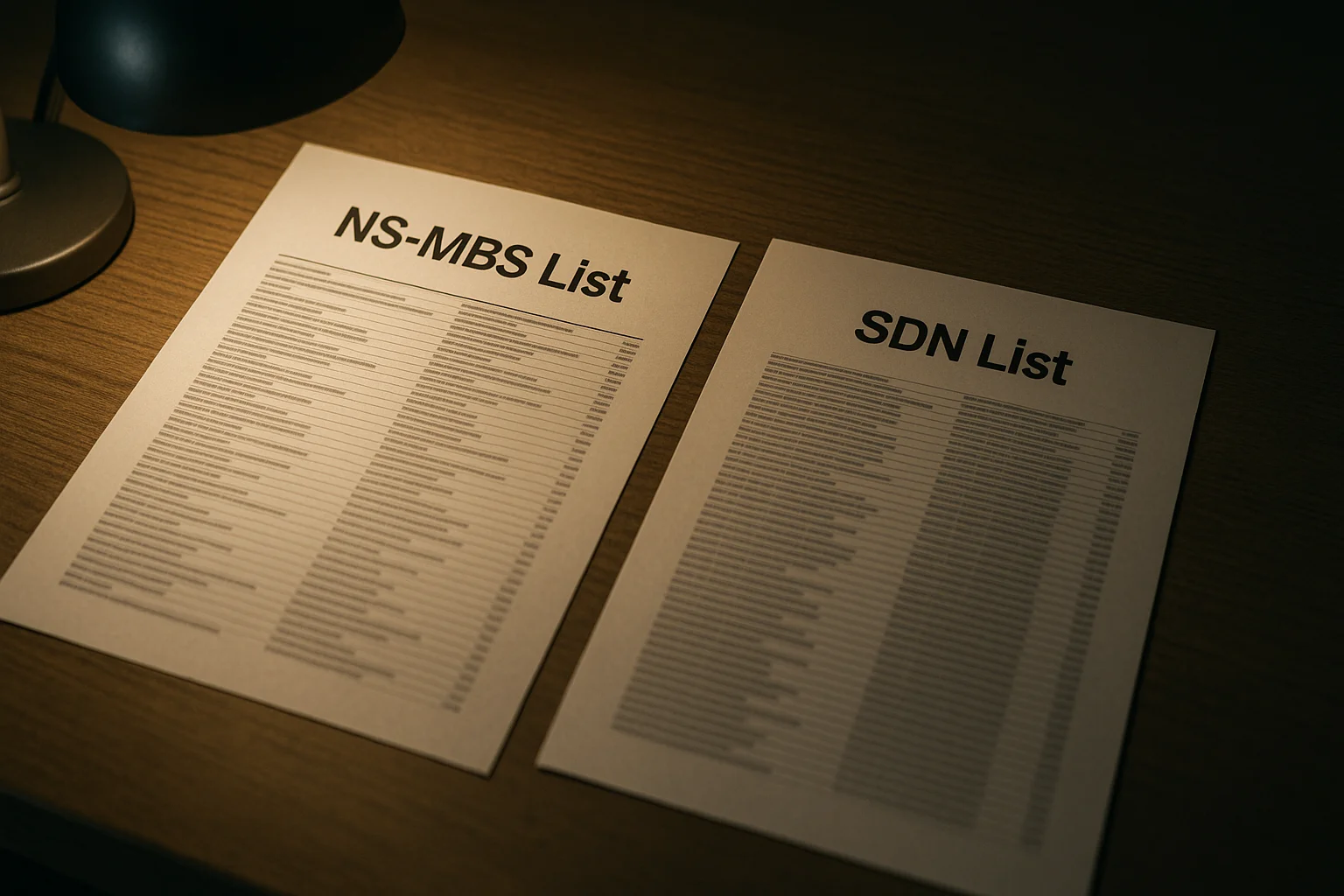
Here’s a common misconception: there is no single “U.S. Sanctions List.” That term is just a generic way of referring to the many different lists maintained by the U.S. government, mostly by OFAC. These include the notorious SDN List, the SSI List, the Foreign Sanctions Evaders (FSE) List, and the Non-SDN Menu-Based Sanctions List (NS-MBS). The NS-MBS List applies a middle-ground approach: rather than a single blanket prohibition, it attaches one or more specific, menu-based restrictions (such as bans on U.S. government contracting or export licensing) to each listed party, depending on the sanctions authority that triggered the listing. Each list comes with its own set of rules, making it critical for compliance teams to know exactly which list a counterparty is on.
What is the Foreign Sanctions Evaders List?
The Foreign Sanctions Evaders (FSE) List is another tool in OFAC’s arsenal. It names foreign individuals and entities caught violating, attempting to violate, or helping others evade U.S. sanctions. While the SSI list targets sectors of an economy (like Russian energy), the FSE list targets specific bad actors for their role in illicitly skirting sanctions, often related to Iran and Syria.
It’s worth noting that, as of December 18, 2025, the last remaining name was removed from the FSE List, leaving it currently empty. That doesn’t mean the mechanism is retired — OFAC can add a party to the FSE List at any time, and when it does, the penalties for dealing with an FSE-listed party can be significantly more severe than for an SSI entity. But as things stand in 2026, the FSE List itself has no active listings.
What actions are prohibited by the SSI Directives?
The prohibitions for entities on the SSI List are spelled out in four distinct Directives under E.O. 13662. A company’s listing will specify which directive applies. You have to get this right.
- Directive 1 (as amended): This hits the financial services sector. It prohibits U.S. persons from any dealings in new debt longer than 14 days maturity or new equity for listed entities. This means even standard 30-day payment terms, a common business practice, are forbidden as they constitute a form of short-term debt.
- Directive 2 (as amended): Focused on the energy sector. It prohibits U.S. persons from dealing in new debt of longer than 60 days maturity for entities listed here. (This maturity was tightened from an original 90 days, showing how these rules can change.)
- Directive 3: Aims at the defence sector. Prohibits dealings in new debt of longer than 30 days maturity for these entities.
- Directive 4 (as amended): This one is different. It prohibits providing goods, services (except financial), or technology for exploring or producing oil in deepwater, Arctic offshore, or shale projects within Russia.
How should a business screen for SSI List entities?
Screening for the SSI list is not a simple yes/no check. It’s a multi-step process that demands more than a basic name search. Our guide on how to check a person or company against the OFAC sanctions list walks through the full process — in short, it comes down to four steps:
- Screen Your Counterparties: Start by screening names of all customers, suppliers, and partners against OFAC’s Consolidated Sanctions List data, which includes the SSI List. You can use commercial software or OFAC’s free Sanctions List Search tool.
- Pinpoint the Applicable Directive: A potential match is just the beginning. The next, vital step is to find out which Directive (1, 2, 3, or 4) applies. OFAC’s official list data includes this information. Missing this step is a common and serious error.
- Analyze Your Specific Transaction: With the directive known, you must dissect the deal you’re about to do. Does it involve new debt or equity? What’s the maturity on that debt? Are you providing services for a Russian shale oil project?
- Make the Call: If your transaction is forbidden by the directive, you cannot proceed. You can’t offer 30-day payment terms to a company under Directive 1 (with its 14-day limit). But if they pay you upfront, the sale is likely permissible. This is where the real analysis happens.
What is the Latest OFAC Sanctions List?
There is no such thing as “the” latest list in a static sense. OFAC’s lists are alive. They change frequently based on world events and U.S. policy decisions. The only reliable source is the live data from the U.S. Department of the Treasury. Your business must use current data files for screening or the real-time search tool on OFAC’s website. An official SSI list might be dated July 27, 2026, but a new one could drop tomorrow without warning.
What are the key takeaways for compliance teams?
Effective SSI compliance goes beyond the basics. Several easily overlooked principles can make or break your program.
- A “hit” is where the work begins: An SSI match is not the end of the line. It’s a trigger for analysis. Your team must be trained to dig into the four Directives and understand their specific prohibitions to decide if a deal is actually illegal.
- The 50 Percent Rule is always in play: Here’s a critical trap. OFAC’s 50 Percent Rule states that if one or more SSI-listed entities own 50% or more of another company, that owned company is also subject to the same SSI rules—even if its name isn’t on any list. This makes thorough ownership due diligence absolutely essential.
- Sanctions are a moving target: Because sanctions are a tool of foreign policy, OFAC can update the SSI list with little to no notice. Your compliance program must have a solid process for updating screening data constantly and keeping up with changes to the directives themselves.
⚠️ Time is critical — every day matters
Get a free case assessment
Our team specialises in cases with an international element. We review applicable treaties, assess risks, and prepare an action plan.
🔒 Confidential · Response within 24h · No obligation
Frequently Asked Questions
What is SSI List OFAC?
“SSI List OFAC” refers to the Sectoral Sanctions Identifications list from the U.S. Treasury’s Office of Foreign Assets Control. It pinpoints entities within the Russian economy facing specific, non-blocking sanctions. This isn’t a total ban. Instead, it restricts certain financial activities, like issuing new debt or equity. For businesses, this means you can’t simply block a listed entity; you must understand the nuanced rules around debt maturity and investment, making compliance a more complex judgment call.
What is the U.S. Sanctions List?
The “U.S. Sanctions List” is a broad, informal name for the various rosters of sanctioned people, companies, and ships maintained by U.S. agencies, primarily OFAC. No single, official government document is actually called this. The term bundles together distinct lists like the SDN and SSI lists, and using such a vague phrase in compliance or legal settings can create dangerous confusion. Always be specific about the list in question.
What is the Foreign Sanctions Evaders List?
The Foreign Sanctions Evaders (FSE) List is one of OFAC’s more pointed lists. It specifically names foreign individuals and entities who have already violated—or tried to violate—U.S. sanctions against countries like Iran or Syria. It also includes those who helped someone on the SDN List hide their transactions. A party on the FSE list is a major red flag, signaling a documented history of deceptive financial behavior and making any transaction with them, even one that seems legitimate, exceptionally high-risk.