OFAC Watchlist: Screening Guide & Compliance

A Turkish freight forwarding company processed a wire transfer for agricultural equipment in February 2026. Three days later, OFAC investigators froze the transaction—the end recipient appeared on the Sectoral Sanctions Identifications List under a variant spelling. The compliance officer had screened only the SDN List, not realizing OFAC maintains four separate sanctions databases. The company faced a penalty demand of $82,116 for two violations.
The OFAC Watchlist is a master directory of individuals, companies, and countries restricted from doing business with the US. It matter because violating these sanctions carries severe federal penalties, and due to the global dominance of the US dollar, being placed on it effectively cuts an entity off from the international financial system.
What Is the OFAC Watchlist and Why Does It Matter?
OFAC—the Office of Foreign Assets Control, nested within the U.S. Treasury’s Office of Terrorism and Financial Intelligence—publishes the sanctions screening databases that every company handling international payments must navigate. The Specially Designated Nationals (SDN) List dominates most compliance programs. It contains over 6,500 entries as of the June 11, 2026 update. Each entry represents an individual, company, aircraft, or vessel whose assets are blocked under U.S. jurisdiction and with whom U.S. persons are generally prohibited from conducting any transactions.
The President’s power to impose these restrictions flows from the International Emergency Economic Powers Act (IEEPA), which authorizes commerce regulation following a declared national emergency. Sanctions programs target specific countries—Iran, North Korea, Syria, Cuba, Russia, and regional zones including Crimea—as well as transnational threats like terrorism, narcotics trafficking, weapons proliferation, and human rights violations. Each program operates under its own Executive Order and implementing regulations codified in Title 31 of the Code of Federal Regulations.
Non-compliance carries teeth. Civil penalties for sanctions violations reach up to $20,529 per transaction or twice the transaction value, whichever is greater, under regulations effective January 2026. Criminal penalties under 31 U.S.C. § 1705 include fines up to $1 million and imprisonment for up to 20 years for willful violations. OFAC’s 2025 Enforcement Report documented 187 settlements totaling $94.3 million, with the median penalty exceeding $280,000. That’s not theoretical risk—it’s the price your company pays if screening fails. This is why building an OFAC watchlist compliance program is not optional but a core operational requirement for any organization exposed to sanctions risk.
⚠️ Time is critical — every day matters
Get a free case assessment
Our team specialises in cases with an international element. We review applicable treaties, assess risks, and prepare an action plan.
How Does OFAC’s Sanctions Screening Actually Work?
Start at sanctionssearch.ofac.treas.gov. The Sanctions List Search tool uses approximate string matching—fuzzy logic—to catch misspellings, transliteration variations, and reversed name patterns common in international transactions. A Turkish national named “Mehmet Ali Kaya” might match “Ali Mehmet Kaya,” “Mehmed A. Kaya,” or “M. Ali Kayah” depending on your confidence threshold setting.
That slider matters. Lower thresholds (60-75) catch more phonetic and spelling variations but flood your compliance team with false positives—sometimes dozens per search requiring manual review. Higher thresholds (85-95) reduce noise but risk missing genuine hits buried in transliteration differences or data-entry errors within source records. OFAC offers no recommended setting, which means you calibrate based on your risk appetite and how many hours your team can spend reviewing potential matches.
A system flag is not a sanctions violation. After the screening software flags a potential match, compliance teams must verify through due diligence before blocking a transaction or rejecting a customer. Verification compares identifying details beyond the name: date of birth, passport number, national identification number, business registration details, known addresses, and associated entities listed in the SDN_ENHANCED.XML file. A genuine match requires corroborating data points—name similarity alone does not trigger liability, but proceeding with a transaction after identifying a true match absolutely does.
What Lists Beyond the SDN Are Part of OFAC Compliance?
The Foreign Sanctions Evaders List (FSEL) identifies individuals and entities that violated, attempted to violate, or conspired to violate U.S. sanctions through third-party intermediaries or shell company structures. Created under Executive Order 13608 (2012), it targets sanctions evasion networks using front companies in non-sanctioned jurisdictions to circumvent restrictions on Iranian, Syrian, or North Korean commerce. FSEL-listed parties face the same asset-blocking requirements as SDN entries—no distinction in legal effect, only in how they came to OFAC’s attention.
The Non-SDN Iran Sanctions Act List operates differently. It contains entities meeting Iran Sanctions Act criteria but not formally designated as SDNs. U.S. persons face prohibitions on specific transaction categories—financing significant infrastructure projects, purchasing Iranian petroleum products—without comprehensive asset freezes. Standard SDN searches will not flag these parties. Missing this list means complying with part of OFAC’s mandate while exposing yourself to violations under the other.
The Sectoral Sanctions Identifications List (SSIL) emerged from Executive Order 13662 (2014) targeting Russian entities in energy, financial services, and defense following the Crimea annexation. Here’s where the complexity deepens. SSIL entries face directive-specific prohibitions rather than comprehensive blocking. Directive 1 restricts debt financing over 30 days for certain Russian financial institutions; Directive 2 limits equity and debt financing for energy companies; Directive 4 prohibits goods, services, or technology supporting Russian deepwater, Arctic offshore, or shale oil projects. A transaction with an SSIL party is not automatically prohibited—the specific directive determines whether you can proceed. Misidentifying a party as fully blocked when they’re only subject to sectoral restrictions (or vice versa) still violates OFAC regulations, just differently.

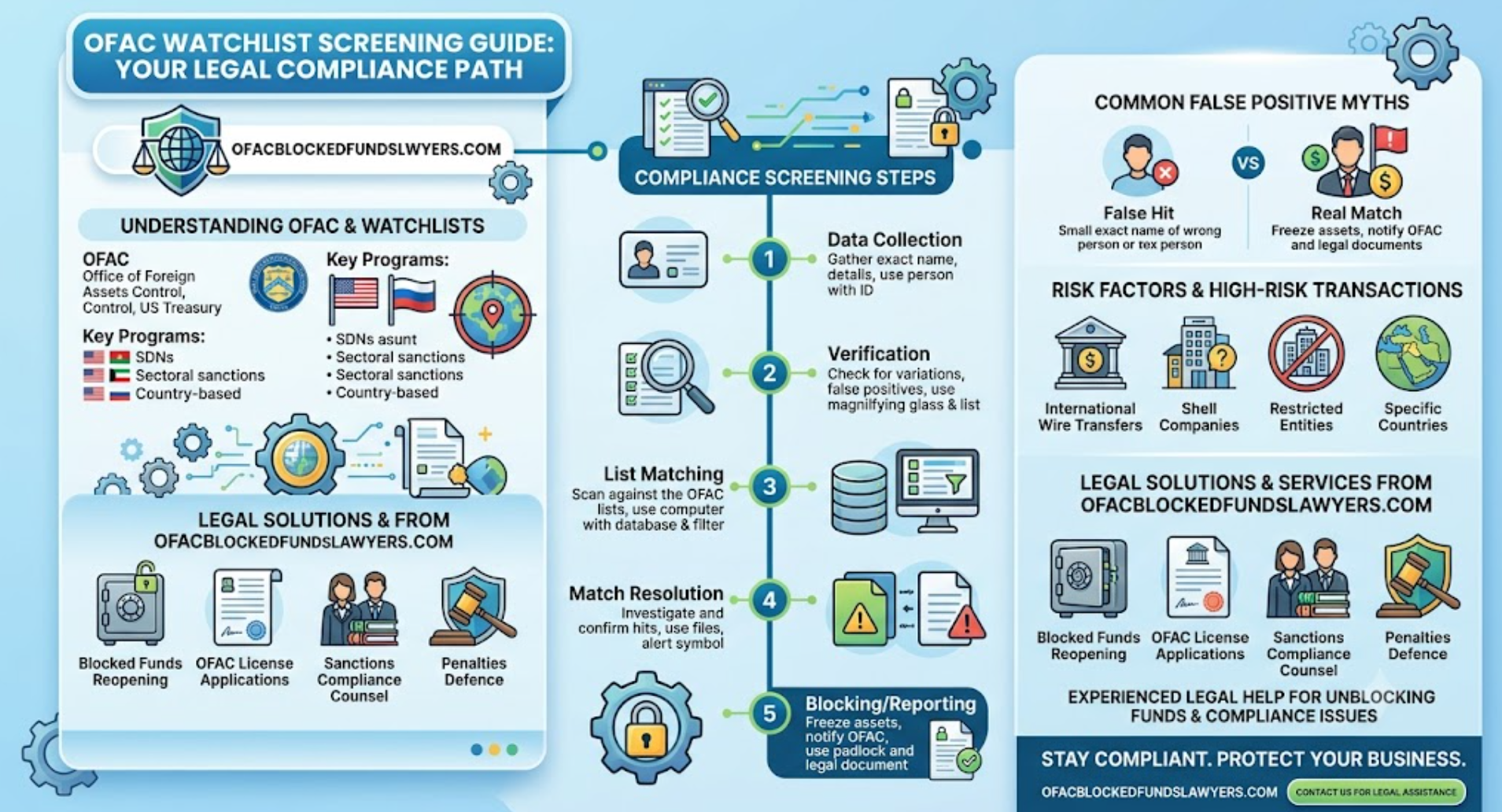
Which Lists Are Commonly Screened Together with OFAC?
OFAC’s own databases are rarely screened in isolation. Because sanctioned individuals and entities frequently appear across more than one government’s records, most compliance programs run a combined check against several sanctions and watchlist sources at once. The lists most commonly screened alongside OFAC include:
- OFAC SDN List — the primary U.S. list of individuals and entities whose assets are blocked and with whom transactions are generally prohibited.
- Consolidated Sanctions List — OFAC’s aggregated non-SDN list, combining sectoral and program-specific U.S. restrictions that carry different legal effects than a full SDN designation.
- BIS Entity List — maintained by the Commerce Department’s Bureau of Industry and Security, this list restricts the export, re-export, or transfer of specific goods and technology to named parties. It targets trade in controlled items rather than blocking assets outright, so a party can appear on the BIS Entity List without being an SDN, and vice versa.
- INTERPOL Notices — including Red and Diffusion Notices, issued by INTERPOL at a member country’s request to seek the location or provisional arrest of an individual pending extradition. These are law-enforcement alerts, not sanctions designations, and carry no automatic transaction-blocking effect on their own.
- UN Sanctions — sanctions lists adopted by the UN Security Council, binding on all UN member states. A UN designation may or may not have a corresponding OFAC entry, since each body designates independently.
- EU Consolidated List — the European Union’s equivalent to the SDN List, covering asset freezes and restrictions across all EU member states.
- UK OFSI List — maintained by the UK’s Office of Financial Sanctions Implementation, applying UK-specific sanctions that frequently mirror, but don’t always exactly match, U.S. and EU designations.
The practical distinction matters: an SDN or Consolidated List match triggers an asset freeze under U.S. law. A BIS Entity List match restricts specific export transactions rather than blocking all dealings. An INTERPOL Notice reflects a law-enforcement request, not a sanctions designation. And a UN, EU, or UK listing carries legal force in its own jurisdiction, which may or may not align with what appears on OFAC’s watchlist. Screening against only one of these sources leaves the others uncovered — which is why comprehensive compliance programs treat OFAC’s watchlist as one part of a broader screening process, not the entire picture.
Who Appears on the OFAC Watchlist and Why?
Designation happens when administrative records demonstrate involvement in sanctionable conduct. Evidence typically comes from intelligence community reporting, law enforcement investigations, diplomatic communications, or open-source research including corporate registries and media reports. The legal standard is “reasonable cause to believe” rather than criminal-conviction certainty, meaning OFAC can act on intelligence assessments without waiting for court proceedings.
Geography tells the story. The June 2026 SDN List includes approximately 1,850 entries connected to Russian sanctions programs—individuals linked to the Kremlin, defense industry executives, and oligarchs who funded the Ukraine invasion. Another 1,200 entries target Iranian proliferation and terrorism support networks. North Korea accounts for 780 designations covering government ministries and revenue-generating entities. Syria claims 340 entries targeting regime officials and associated businesspersons. Venezuela, Belarus, Nicaragua, and Myanmar follow, each reflecting political crises or human rights violations. Your company’s exposure depends on whether your supply chains intersect these geographies.
Sectoral patterns extend beyond state actors. OFAC designates transnational criminal organizations—Mexican cartels, Colombian FAOC remnants trafficking narcotics. Terrorism finance networks appear as Hizballah commercial entities, al-Qa’ida fundraising facilitators, ISIS oil smuggling operations. Weapons proliferation agents include suppliers to North Korean missile programs and Iranian UAV manufacturers. Cyber threat actors—ransomware operators, state-sponsored hacking groups—round out the list. Watchlist entries span commercial enterprises, charities, shipping companies, and financial institutions across every sector imaginable.
| OFAC Sanctions List | Primary Purpose | Legal Effect | Approximate Entries (2026) |
|---|---|---|---|
| SDN List | Comprehensive asset blocking for designated parties | All property blocked; U.S. persons prohibited from all transactions | 6,500+ |
| Foreign Sanctions Evaders List | Target sanctions-evasion networks | Same blocking requirements as SDN entries | 280+ |
| Non-SDN Iran Sanctions Act List | Restrict specific Iranian commerce categories | Categorical transaction prohibitions (not comprehensive blocking) | 190+ |
| Sectoral Sanctions Identifications List | Apply directive-specific restrictions to Russian entities | Prohibitions vary by directive (debt, equity, goods/services) | 320+ |
How Should Your Organization Screen Against the OFAC Watchlist?
Screening belongs at every transaction boundary. Customer onboarding (account opening, relationship establishment). Payment processing (wire transfers, ACH, checks). Trade finance (letters of credit, documentary collections). Supply chain management (vendor due diligence, shipping manifest review). Screening frequency tracks risk exposure—financial institutions screen in real-time for payment transactions, while lower-risk businesses may conduct periodic batch screening of customer and vendor lists weekly or monthly. The more cross-border activity you handle, the more frequently you screen.
Two paths exist: OFAC’s free Sanctions List Search tool for manual queries, or commercial compliance software for automated bulk screening. The free tool works for occasional international transactions. Enterprises processing hundreds of cross-border payments daily cannot afford manual name-by-name lookups—they need integrated systems that screen transaction parties against watchlists in milliseconds and route potential matches to compliance officers for human review. Commercial platforms add automatic list updates, workflow management for false-positive resolution, and audit trail generation for when regulators examine your compliance infrastructure. The cost of software (typically $10,000–$50,000 annually for mid-market firms) becomes trivial compared to a single OFAC settlement.
File management protocols matter enormously for defensible compliance. OFAC publishes the SDN_ENHANCED.ZIP file (6.32 MB as of June 11, 2026)—an XML-formatted dataset designed for import into compliance databases. Organizations using offline screening must download updates weekly minimum. Here’s why: sanctions obligations take effect the instant OFAC publishes a new entry. “I didn’t know they were added last week” won’t save you. The compressed file includes the primary SDN list, all consolidated non-SDN lists, and identifying details (dates of birth, passport numbers, vessel IMO numbers, aircraft tail numbers) you’ll need for accurate due diligence.
31 C.F.R. § 501.805 requires written policies documenting your screening procedures, staff training records, technology specs, and transaction-by-transaction records showing the date, method, and outcome of each screening. When your compliance officer reviews a potential match and concludes it’s a false positive, that decision needs documentation—the specific verification steps taken and the identifying details that distinguished the transaction party from the listed individual. Keep these records for five years. OFAC will request them during investigations or audits, and you’ll be grateful they exist.
What Are Common Compliance Mistakes and How to Avoid Them?
Incomplete list coverage remains the most frequent violation OFAC prosecutes. Screen only the SDN List? You’ve missed the Foreign Sanctions Evaders List, Non-SDN Iran Sanctions Act List, and Sectoral Sanctions Identifications List—each one capable of creating real liability when prohibited transactions slip through. A 2025 enforcement action against a European logistics company illustrates the cost: $1.2 million settlement. The violation centered on 14 transactions with SSIL-listed Russian energy firms that passed SDN screening but violated Directive 4 prohibitions on providing logistics services to sanctioned oil projects. Effective compliance screens every transaction against all four primary OFAC lists.
Inadequate due diligence after screening matches cuts both ways. Block a wire transfer based solely on a name match—without verifying date of birth, nationality, or business details—and you’ve frozen funds belonging to an innocent person who happens to share a name with an SDN-listed individual. That triggers legal claims and regulatory criticism for sloppy verification. On the flip side, clear a transaction after identifying a weak match without documenting your verification analysis, and you’ve handed OFAC exactly what it needs: an institution unable to demonstrate good-faith compliance if questioned later.
Negligent record-keeping and policy gaps show up consistently in OFAC penalties. Examiners expect written compliance programs addressing screening technology, staff responsibilities, escalation procedures, list-update protocols, and quality-assurance testing. No documented policies? Failed to retain screening records? You’ve created the appearance of indifference to sanctions obligations—and OFAC’s Economic Sanctions Enforcement Guidelines explicitly factor this into penalty calculations. Organizations with weak compliance programs pay median penalties three times higher than those where violations stemmed from isolated mistakes despite robust controls. Proper screening obligations against OFAC lists must therefore be clearly defined, documented, and continuously enforced within the compliance framework.
Delayed response to screening hits converts near-misses into actual violations. When compliance systems flag a potential SDN match, block the transaction immediately. Don’t process it while you investigate. A 2024 enforcement action against a Texas oil-field services company cost $685,000 because managers authorized “provisional payment processing to avoid delaying the project” despite preliminary compliance flags. Seven transactions cleared and completed to Syrian SDN-listed entities that should have been stopped the moment the screening alert was generated. This approach treated sanctions screening as an administrative formality rather than a mandatory pre-transaction control.